Circle Wellness vs Discover Balance: 2026 Spa Comparison

Updated: 2 days ago
Table of Contents
Circle Wellness vs Discover Balance: What Each One Actually Offers
Circle Wellness: Private Thermal Circuits
Discover Balance: A Note on the Name
Side-by-Side Comparison: Services, Pricing, and Access
The Benefits of Float Therapy and Other Recovery Services
HSA Eligible Wellness Services: What You Can Pay For with Pre-Tax Dollars
How to Choose a Recovery Spa That Fits Your Needs
The six-dimension evaluation framework
How to use the framework
Where FloatWell Fits In: Insurance Billing and HSA Flexibility
Frequently Asked Questions
Last Updated: September 12, 2026
Circle Wellness vs Discover Balance: What Each One Actually Offers
Circle Wellness vs Discover Balance is a comparison that trips up a lot of people searching for recovery services, because the two names lead to very different places. Circle Wellness is a private thermal spa operator built around self-guided heat-and-cold circuits. Discover Balance is a wellness brand name that overlaps in search results with a major financial institution, which means some of the traffic looking for it never wanted a spa at all. This comparison from FloatWell breaks down what each one actually is, what it costs, and how to decide whether either fits your recovery routine.
Winner for recovery-focused care: FloatWell. Circle Wellness is the stronger pick if you want a private, self-guided thermal circuit for two. If you need insurance-billed recovery or HSA-eligible services, FloatWell is the practical choice.
Circle Wellness: Private Thermal Circuits
Circle Wellness is a private, self-guided thermal spa experience built around automated wellness circuits. Sessions run in a reserved suite for up to two people, with no staff present and no shared space.
The six-step format moves through cedar soaking tubs, WellPod saunas, cold plunges, open-air rain showers, and heated river stone beds. Because access is automated, your session starts and ends on your own schedule.
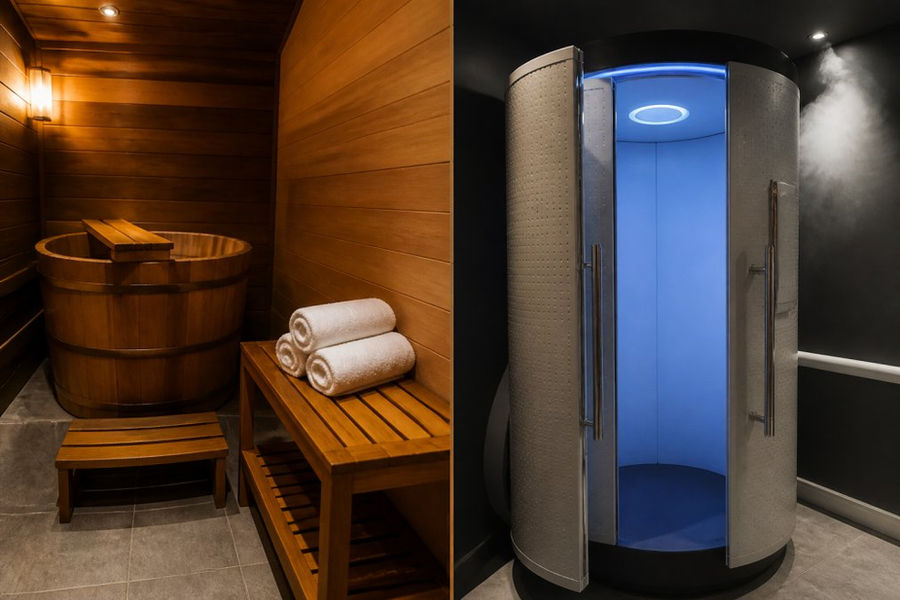
The trade-off is price. Circle Wellness pricing depends on location, time, and session length. That is a premium for privacy and design, not for clinical recovery support.
Discover Balance: A Note on the Name
Here is the part most guides get wrong: "Discover Balance" is not a single, clearly defined spa brand. The phrase pulls in two directions at once.
On one side, searches for it surface Discover it Cash Back, a credit card product with a 0% introductory APR on balance transfers and no annual fee. That is a financial tool for managing debt, not a wellness service.
On the other, local businesses use "balance" in their names, so results vary by region and often point to massage or bodywork studios rather than thermal circuits. Before you book anything under this name, confirm the business type, its service menu, and its professional certification standards. A name alone tells you nothing about what happens in the room.
Side-by-Side Comparison: Services, Pricing, and Access
The table below summarizes how these options differ on the factors that decide most bookings: what you get, what it costs, and how you pay. Read it as a starting point, then use the evaluation framework in the next section to weigh the factors that matter for your situation.
Factor | Circle Wellness | FloatWell |
Core service | Self-guided thermal circuit | Float therapy, cryotherapy, infrared sauna, red light therapy |
Session format | Private suite, up to 2 people | Individual therapeutic sessions |
Typical session length | Multi-step circuit | Varies by modality; float sessions commonly run 60 minutes |
Pricing model | Pay-per-session | Pay-per-session or membership |
Starting price | Contact for current pricing | Contact for current pricing |
Insurance billing | No | MVA insurance billing for qualifying car accident recovery |
Pre-tax payment | Not stated | HSA cards accepted |
Staff presence | None during session; automated access | Staff on site to guide first visits |
Cancellation and rescheduling | Varies by location; confirm at booking | Confirm directly with the spa |
Best for | Couples wanting private thermal time | Recovery, pain relief, and insurance-supported care |
Three things stand out once you line the rows up.
First, Circle Wellness sells an experience; the value is in the private, multi-sensory environment. There is no clinical claim attached to the circuit, no insurance pathway, and no staff in the room. If what you want is a quiet, design-forward hour with a partner, that is the product. If what you want is a documented therapeutic outcome, the product is not built for that.
Second, the payment mechanics matter more than most buyers expect. If you are recovering from a car accident, whether a provider bills insurance changes your out-of-pocket cost far more than a per-session rate does. A $132 session you pay for yourself and a session billed to MVA insurance are not comparable line items, even if the sticker prices look similar.
Third, the comparison is asymmetric on purpose. Circle Wellness is a single, well-defined experience. FloatWell is a multi-modality recovery provider. That means the honest question is not "which is better" but "which problem am I trying to solve", a private thermal hour for two, or a recovery routine you can repeat, pay for with pre-tax dollars, and in some cases bill to insurance.
Key Takeaway If you only remember one row from this table, make it the payment row. Insurance billing and HSA acceptance change the effective cost of a service far more than the advertised per-session price does.
The Benefits of Float Therapy and Other Recovery Services
Float therapy is a sensory-reduction treatment in which you lie in a shallow pool of body-temperature water saturated with Epsom salt, removing gravity, sound, and light so the nervous system can settle (PubMed). Many people find it useful for muscle tension, sleep quality, and stress reduction, though individual responses vary and it is not a substitute for medical treatment.
The wider category works on a similar principle. Cryotherapy, infrared saunas, and red light therapy each apply a controlled physical stimulus, cold, heat, or specific light wavelengths, and the body responds. Therapeutic bodywork and massage therapy follow the same logic through manual pressure rather than temperature.
What matters is matching the modality to the goal:
Chronic muscle tension and desk-job stress: float therapy or massage therapy
Post-training soreness in athletes: cryotherapy and compression
Insomnia and difficulty winding down: infrared sauna, ideally in the evening
Skin rejuvenation goals: red light therapy and facial treatments
A common mistake is stacking services too quickly. Start with one modality, run it two to three times, and judge by how you sleep and move in the days after.
HSA Eligible Wellness Services: What You Can Pay For with Pre-Tax Dollars
HSA eligible wellness services are treatments that qualify for reimbursement from a Health Savings Account because they are considered medical care under IRS rules. The key word is medical: a service needs a legitimate therapeutic purpose, not just a relaxation benefit.
The IRS publishes the governing rules in IRS Publication 969 on Health Savings Accounts, and the agency's guidance on medical and dental expenses defines which categories generally qualify. Because eligibility depends on your specific diagnosis, prescription, or plan, confirm with your HSA administrator before booking. FloatWell accepts HSA cards for treatments, which removes the reimbursement paperwork for many clients.
Watch Out Paying with an HSA card is not the same as automatic approval. If a purchase does not meet IRS requirements, you may owe taxes and a penalty on the withdrawal. Get written confirmation from your HSA administrator first.
A practical sequence for anyone planning to use pre-tax dollars:
Ask your physician whether the treatment is medically indicated for your condition
Request a Letter of Medical Necessity if your administrator requires one
Confirm the provider accepts HSA cards directly
Keep the itemized receipt with your records
How to Choose a Recovery Spa That Fits Your Needs
Most guides in this category are either directories or promotional pages. What is missing is a neutral way to compare two providers on the same terms. The framework below is built for that: score each provider you are considering on the same six dimensions, then compare the totals. It works whether you are weighing a private thermal circuit against a recovery-focused spa, or two local studios against each other.
The six-dimension evaluation framework
1. Clinical fit, does the service match the problem? Aches from training, tension from a desk job, and pain from a car accident are three different problems with three different answers. Write down your actual problem in one sentence before you look at any provider. If a spa's menu does not name a service that plausibly addresses that sentence, it is the wrong spa regardless of how nice the room is.
2. Payment pathway, who is actually paying? This is the question buyers skip, and it is the one that changes the math most. Ask three things in writing:
Does the provider bill insurance directly, or do you pay upfront and seek reimbursement?
Does the provider accept HSA or FSA cards?
What documentation will you receive for a reimbursement claim?
If you are recovering from a motor vehicle accident, a provider that bills MVA insurance can shift most of the cost away from you. FloatWell bills MVA insurance for car accident recovery, which is unusual in this category. If you plan to use pre-tax dollars, confirm HSA acceptance before you book, see the HSA section above for the IRS rules that govern eligibility.
3. Total commitment, what does a realistic month cost? A membership model lowers the per-visit cost for frequent users; pay-per-session keeps you flexible. Neither is better in the abstract. Estimate how many visits you will realistically make in a month, multiply by the per-session rate, and compare that number to the membership price. If you cannot honestly commit to the frequency the membership assumes, pay-per-session wins on value even at a higher sticker price.
4. First-visit experience, what happens when you walk in? Ask directly:
Will someone walk me through the equipment and set expectations?
How long should a session run for my situation?
What does post-treatment care involve?
What are the hygiene standards between clients?
A provider that cannot answer these in plain language before you book is telling you something about how the visit will go.
5. Cancellation and rescheduling terms, what does it cost to change your mind? This is the most commonly buried term in the category. Ask for the cancellation window, the no-show fee, and whether unused membership visits roll over. A generous cancellation policy is a signal that the provider expects you to be a repeat customer rather than a one-time transaction.
6. Red flags, what should make you walk away?
No single-session option; the only path in is a multi-month commitment
Vague answers about practitioner credentials or certification
No written pricing before you arrive
Pressure to decide on the day of your first visit
Pro Tip Ask for a single trial session before any membership. A provider confident in its service will let you test one modality first. If the only path in is a multi-month commitment, that tells you something.
How to use the framework
Score each provider from 1 to 5 on all six dimensions. Weight the dimensions by what matters to you, if insurance billing is essential, give dimension 2 double weight; if you are buying a one-time gift experience, dimension 3 barely matters. Add the scores and compare. The point is not the number; it is that you are now comparing two providers on the same terms instead of on whichever marketing page you read last.
A common pattern among first-time buyers is to over-weight the room and under-weight the payment pathway. The room is one hour. The payment structure affects every visit you make.
Where FloatWell Fits In: Insurance Billing and HSA Flexibility
FloatWell is a whole-body wellness spa in Vancouver, WA, and the reason it belongs in this comparison is not the service list. It is the payment structure.
Most recovery spas are cash-only and leave you to sort out reimbursement yourself. FloatWell bills MVA insurance for qualifying car accident recovery and accepts HSA cards for treatments, which addresses the two biggest objections people raise before booking: cost and paperwork.
The service range covers float therapy, cryotherapy, infrared saunas, and red light therapy, so you can build a recovery routine across modalities rather than committing to one. Pricing depends on the service and package you choose, and specific rates are available by contacting the spa directly.
Best For People recovering from a car accident who need insurance-billed care, and anyone who wants to use HSA funds for treatments without chasing reimbursement.
If you are weighing a private thermal circuit against a recovery-focused provider, the deciding factor is usually whether you need the cost covered. That is a different question from which room is nicer.
Frequently Asked Questions
What is the difference between a traditional day spa and a wellness recovery center?
A traditional day spa focuses on relaxation and cosmetic treatments like facials and massages. A wellness recovery center, like FloatWell, offers therapeutic services such as float therapy, cryotherapy, and infrared saunas designed to support physical recovery, pain relief, and overall well-being. The key difference is intent: day spas help you unwind, while recovery centers help you heal and restore function, often with insurance-compatible options and HSA eligible wellness services.
Are wellness spa services covered by HSA or insurance?
Some wellness spa services may qualify for HSA reimbursement if a licensed medical provider deems them medically necessary for a diagnosed condition. FloatWell accepts HSA cards and bills MVA insurance for car accident recovery. However, coverage varies by plan and provider. Always check with your HSA administrator or insurance company before booking to confirm whether your specific treatment qualifies for reimbursement.
How do I determine which wellness center offers the best recovery technology?
Look for centers that offer a range of evidence-informed services, transparent pricing, and qualified staff. Ask about the specific technologies used, such as float tanks, cryotherapy chambers, or infrared saunas. Check whether the center accepts HSA cards or insurance billing, which signals a medical-grade approach. Reading verified customer reviews and asking about staff certifications also helps you gauge quality before committing.
How often should I visit a wellness center for optimal recovery?
Frequency depends on your goals and condition. For general stress reduction, once a week or every other week works well. For injury recovery or chronic pain, a practitioner might suggest two to three sessions per week initially, tapering as you improve. FloatWell staff can help you build a schedule based on your specific needs, whether you are recovering from a car accident, managing athletic strain, or addressing burnout.
Recovery works best when it is consistent, and consistency usually breaks down over cost and convenience rather than motivation. If you are managing pain from an accident, training load, or chronic tension, FloatWell bills MVA insurance for qualifying car accident recovery, accepts HSA cards, and offers float therapy, cryotherapy, infrared sauna, and red light therapy under one roof. Book an appointment with FloatWell and build a recovery routine you can actually keep.
Book an Appointment


Comments